Each new need immediately awakens the idea of association.1
— Alexis de Tocqueville, Democracy in America
Introduction
The characteristic institution of industrial capitalism is the firm. A firm brings together land, labor, capital, machinery, and knowledge in order to produce outputs that consumers value. This essay will argue that the dominant institution of the post-AGI economy will instead be the “club”: a bounded constituency with continuing authority to form and revise common ends, govern their evolving specifications, commit demand behind them, and commission the corresponding production.
In previous essays I considered how value will change in a post-AGI society, and also thought about what happens when demand becomes a constraint on value rather than supply. I argued that if AI makes the supply side vastly more efficient, there will be both immediate-term and long-term constraints on how much demand is available.
Although it is difficult to imagine a total limit to human desire, several mechanisms can constrain demand locally or temporarily. In the short term, the supply of new goods can simply grow faster than people can discover, evaluate, finance, and absorb it. At the limit, we might expect some asymptote beyond which the value of a marginal good for a human diminishes to a very low level.
More concretely, we can consider “satiable goods.” By analogy with rivalrous goods (whose available supply can be exhausted through consumption), a satiable good has a stock of demand that can eventually be exhausted through production. Even if human wants remain infinite in the abstract, demand for particular satiable goods need not be. For rivalrous goods, available supply is finite, so competition among buyers for a fixed stock can become zero-sum: one buyer’s acquisition leaves less for others. For satiable goods, remaining demand is finite, so competition among sellers for that demand can likewise become zero-sum: one seller’s sale leaves less demand for others2.
If the bottlenecks in value creation migrate from the production of goods to the production, discovery, aggregation, and organization of demand, then institutions built around the supply and manufacture of goods should lose relative importance3. In their place, we would therefore expect new organizations to form around the now-scarce demand-side activities, such as identifying what people want, coordinating their choices, and turning those choices into commitments on which producers can act. These organizations are clubs.
The essay proceeds in two stages. The sections on the firm, industrial production, cybernetic production, and the barbell economy explain why AI may make execution portable and shift value toward organized demand. The Social Construction of Demand then explains why forming that demand remains a social and institutional problem. Readers willing to grant these prerequisites may skip directly to The Nature of the Club, which develops the club’s economics and governance. The Future of the Club considers its likely economic and political development, while Galaxy Brain collects the more speculative consequences.
This is a comparative-static claim, not a forecast of one particular world: as execution becomes more portable, durable organization migrates from control of productive means toward the formation, governance, and commitment of ends, with the extent of that migration depending on how portable the relevant execution becomes. The post-AGI club is the limiting case of this process, and the projections that follow should be read as illustrations of its mechanisms rather than as a definitive forecast.
The Nature of the Firm
Before considering clubs in detail, let us first consider their highly theorized dual institution, the firm. Why do firms exist in the first place? Why not simply engage the market directly for all transactions? In theory, all production could be coordinated through prices and contracts. But in reality, a lot of economic activity occurs inside firms.
The creation and sale of complex goods (or the complex production of simple goods at scale) is made more efficient through cooperation among various agents. Historically, we think of these agents as people, but they also include animals and, increasingly, computerized systems. However, participants in the collective may have different objectives or private information, or act under uncertainty. Since every action, contingency, and state of the world cannot reasonably be specified, all contracts are in practice costly, uncertain, and incomplete4. A product may result from thousands of complementary actions by different agents, none of which has material value in isolation. Even when the final value is known, there may be no unambiguous way to determine how much of the value was created by each participant. This makes it difficult to reward contribution, punish obstruction, or determine which agent should possess control5.
Due to these fundamental issues in aligning agents6, several well-known game-theoretic problems occur. Agents may shirk responsibility when their actions cannot be observed, free-ride on the effort of others, conceal private information, fail to coordinate on complementary actions, or refuse to cooperate without credible commitments from the other participants. Principals may be forced to delegate authority to agents with uncertain interests, possibly differing from their own. A valuable investment in one context may later be “held up” by the counterparty when circumstances change.
Principal–agent problems, moral hazard, adverse selection, free-riding, hold-up, commitment problems, and coordination failures are different forms of alignment problems. A group can create a cooperative surplus, but the individually rational behavior of its members does not necessarily maximize that surplus or distribute it in a way that sustains cooperation.
Many of these problems become easier when interaction is repeated7. Agents who expect to meet again can build reputations, reward past cooperation, punish defection, and make credible commitments based on the future value of the relationship. But repeated interaction does not by itself determine whether cooperation should occur through the market or inside a firm. Long-term suppliers can also monitor one another and sustain informal agreements. A firm goes further by placing the repeated game inside a persistent institution that can centralize information, remember history, assign authority, and make continued participation conditional on rule-following.
When is this internal governance cheaper or more effective than coordinating the same agents through repeated market contracts?
Coase famously argued that firms formed because of transaction costs8. Market coordination requires people to discover prices, find counterparties, negotiate terms, specify obligations, monitor performance, and renegotiate when circumstances change. A firm internalizes some of these transactions when internal coordination is cheaper than repeatedly coordinating them through the market.
An employment contract, for example, does not specify every action a worker will perform, but instead establishes a range within which a manager can assign tasks as new circumstances arise. The firm replaces a sequence of separate negotiations with an internal decision-making process.
Internal coordination has costs of its own. Managers have limited attention, information is distorted as it moves through a hierarchy, and incentive and coordination problems may worsen as the organization grows larger9. Firms therefore expand only while the cost of organizing an additional transaction internally remains lower than the cost of coordinating it through the market or another firm10.
Coase’s framework11 explains why a boundary between firms and markets exists, but leaves transaction costs abstract. Later theories specify what firms govern. This might include decision rights, incentives, relationship-specific investments, and productive capabilities.
When contracts run out under uncertainty, firms assign someone authority to decide. Knight12 emphasizes the entrepreneur’s exercise of judgment, while property-rights theories interpret ownership as control over decisions not allocated in advance.13 When joint output cannot be cleanly attributed, firms can use monitoring, compensation, promotion, dismissal, and residual claims to discourage shirking and free-riding.14 Principal–agent theory generalizes this problem to delegated tasks involving hidden actions or information.15
Firms can also protect specific investments from hold-up. Williamson’s transaction-cost economics asks when hierarchy or common ownership can safeguard assets whose value depends on a particular relationship and permit adaptation without bargaining over every adjustment.16 Finally, persistent organizations retain capabilities embedded in routines, reputations, shared concepts, working relationships, and other knowledge that cannot be reduced to a contract or instruction manual.17
Hansmann18 also asks: Who should own the resulting organization? An enterprise can be owned by investors, workers, customers, suppliers, borrowers, or some other class of patrons. Ownership may protect a group from monopoly, lock-in, poor information, or contractual exploitation, but collective ownership also creates costs of governance and disagreement. The efficient owner is therefore the patron class for which the benefits of control most exceed the costs of exercising it.
Taken together, these theories ask three questions:
- Which transactions belong inside the firm rather than the market? (Coase, Williamson)
- Who should own and control the firm when contracts are incomplete? (property rights, Hansmann)
- How should the agents inside be monitored, motivated, and coordinated? (agency, team production, capabilities)
A firm is a system for governing cooperation among agents with different interests and information. Ownership assigns authority, management makes collective decisions, monitoring determines what becomes visible, compensation distributes the surplus, and hiring and dismissal regulate membership. In this sense, the firm can also be seen as a small political institution.
Bringing an activity inside the firm does not eliminate alignment problems, but merely moves them around. Market bargaining, hold-up, and free-riding are traded for conflicts among owners, managers, workers, and divisions. Different organizational forms and methods of altering the boundary, ownership, and internal constitution of firms are engineering choices intended to maximize the value of cooperation while minimizing its costs.
The Industrial Firm
Any customer can have a car painted any colour that he wants so long as it is black.19
— Henry Ford, My Life and Work
In industrialized economies, the productive bottlenecks worth solving were selected based on the relative demand for each output. But buyers didn’t generally need to be organized together in order to express that demand: demand could appear via the market mechanism through prices and orders. Production, on the other hand, requires factories, and factories require capital, machinery, specialized labor, and management to be assembled and governed over time. Demand calls the productive capacity into existence, but the capacity has to be held together inside the firm.
Once capital has been allocated, much of its cost remains whether the factory produces anything or not. Increasing the volume of production spreads those fixed costs across more units. Industrial firms therefore preferred high, predictable throughput, which in turn incentivized standardization.
Scale (which is essentially “repeat the same thing over and over again”) reduces the costs of coordinating inputs, training workers, monitoring quality, and distributing the final product. Firms consequently require markets large enough to absorb standardized outputs. This constrains the types of products that industrialized firms can profitably offer. More generally, firms prefer products to services where possible, since products allow the same capital, design, and organizational knowledge to be leveraged across the greatest possible volume of sales.
Under the conditions of modernity, other institutions tend to fall into similar patterns of homogenization. Schools produce comparable workers; credentials make strangers legible to employers; markets standardize money, measurements, contracts, and product categories; architecture tends toward the interchangeable to allow different businesses to use it under different conditions20. Scale necessitates replaceability and interchangeability, which necessitate homogenization.
The high fixed costs of production create a bottleneck that justifies homogenization. So long as consumers want more food, clothing, housing, transportation, and other manufacturable goods than the economy can easily produce, organizing scarce productive capacity remains the central economic problem. Demand determines what is worth producing, but the firm is organized around the difficult work of producing it. Once the capacity exists, the firm must keep it in use, standardizing the agents and inputs around it and maintaining a market large enough to absorb its output.
The Cybernetic Firm
In the land of the genies, the richest are the best wishers
— Procopio
The industrial firm lowered costs by repeating a standardized output. The cybernetic firm can instead use information about the buyer to adaptively vary its output while retaining a common productive system.
Successive technologies reduced the cost of production and distribution. Industrial machinery reduced the cost of physical repetition. Global logistics expanded the market over which fixed costs could be spread. Software reduced the cost of calculation and administration. The internet reduced the cost of distributing information.
AI may advance this process another step. As the internet made it cheap to distribute existing supply, AI makes many forms of supply cheaper to create, modify, and coordinate. For example, AI lowers the cost of software, design, analysis, administration, translation, instruction, research, customer service, and customization. Combined with robotics and flexible manufacturing, some of the same logic may eventually extend into the physical economy.
Historically, customization was expensive because a different contract, lesson, design, or service for every person required separate human attention. Standardization conserves cognition. AI makes some of this attention reproducible, allowing a common system to produce different outputs for different people without requiring an entirely separate organization for each one.
Products, Services, Commodities, and Fabricators
Industrial standardization made the buyer largely interchangeable from the perspective of production. A car, refrigerator, or air conditioner is designed for a type of customer, not for a particular person. To see what changes when production can respond to a particular buyer, we need to distinguish the specificity of the buyer from the specificity of the seller.
Economic transactions can be classified by considering whether the particular seller or buyer matters. The identity of the seller matters when the output depends on a particular brand, reputation, skill, or productive capability. The identity of the buyer matters when the output depends on the buyer’s identity, circumstances, preferences, or intended use.
This gives us a simple table:
| Buyer is interchangeable | Buyer is specific | |
|---|---|---|
| Seller is specific | Products: cars, novels, SaaS21 | Services: therapy, tutoring, consulting |
| Seller is interchangeable | Commodities: wheat, electricity, or a standardized fastener | Fabricators: print shops, CNC machines, paint mixers |
We can equivalently classify them according to which party holds the specification:
- Commodities: The specification is standardized and external to the buyer–seller relationship
- Products: Seller holds the specification
- Fabricators: Buyer holds the specification
- Services: Buyer and seller share the specification/jointly discover it
These are idealized types, as real transactions can straddle or move across different groups. For example, standardizing tax-preparation services can push what was once a personal service toward a commodity. Similarly, branding can make an otherwise interchangeable seller appear specific22, or technical standardization can make a previously specific seller replaceable.
The undertheorized section of this chart is the fabricators. Among fabricators, the buyer supplies the differentiating specification, while the seller supplies a generalized productive capability. For example, a print shop does not decide which book should exist, but merely executes the specification it receives from the publisher. Similarly, a CNC shop doesn’t design parts, but merely executes production based on what the customer provides. In both cases, the seller can be replaced with an identical one without any meaningful difference to the user, provided all producers are equally able to meet the specification. These businesses can therefore be cutthroat and highly competitive, with vanishing margins.
By analogy, AI systems that produce contracts, curricula, software, images, or research reports from a sufficiently detailed specification may also be fabricators (provided that one model provider doesn’t assume a dominant position in capability). However, AI takes an additional leap, as historically fabricators were limited in their ability to interpret the buyer. What happens when that interpretation, as well as the execution itself, can be reproduced cheaply and reasonably reliably?
| Type | Current business logic | What firms try to do | Likely AI effect |
|---|---|---|---|
| Commodity | Compete on cost, reliability, scale, logistics, and control of scarce inputs. Margins tend to compress. | Escape commoditization by branding, bundling, controlling distribution, or creating switching costs. | AI further compresses informational and design advantages. Commodity producers either become even more efficient or attach themselves to a differentiated interface, ecosystem, or demand pool. |
| Product | Sellers own the specification and spread design costs across interchangeable buyers. Rents accrue to IP, brand, distribution, ecosystem, and product judgment. | Preserve seller specificity. Prevent competitors or customers from carrying the same specification elsewhere. | Product design becomes cheaper and more easily copied. Many product businesses move toward commodities or fabricators unless they retain network effects, proprietary data, regulation, scarce physical assets, or a strong customer relationship. |
| Service | Both parties matter. The seller interprets a particular buyer using skill, trust, context, and judgment, and the spec is shared. Scale is limited by attention and relationship-specific knowledge. | Productize repeated judgment, standardize delivery, train lower-cost agents, or build a firm whose routines reproduce the expert. | AI automates the interpretive layer. Services split: standardized ones become products, personalized but reproducible ones become fabricators, and only services tied to scarce trust, liability, embodiment, authority, or relationships remain seller-specific. |
| Fabricator | Buyer controls the specification. Seller supplies generalized execution. Competition centers on price, quality, speed, and capacity. | Capture more of the specification, customer data, workflow, or interface so the seller becomes harder to replace. | This quadrant expands dramatically. AI can execute highly individualized work while remaining replaceable. If interpretation also becomes reproducible, the valuable asset moves from execution toward the accumulated system that generates the buyer’s specifications. |
AI may greatly expand the fabricator quadrant. Ordinarily, making something specific to a buyer requires a specific human seller, which is why personalization takes the form of a service. A tutor learns about a student, a lawyer learns about a client, and an architect learns about a household. If AI makes this tacit knowledge portable between producers, the buyer can remain specific while the seller becomes increasingly interchangeable. The transaction moves from service to fabrication.
On the other hand, cheaper production does not necessarily turn every differentiated product into a commodity. If AI makes customization cheap, seller differentiation can decline at the same time buyer differentiation increases. The product moves diagonally into fabrication instead. We still receive different curricula, contracts, software, media, and physical objects, but the differences increasingly come from the demand side rather than from the productive organization.
Portable Context
Historically, much of the information held by sellers was not portable and hence could not be transferred. For example, a therapist’s understanding of a patient or a designer’s craft knowledge could not easily be transferred to a competitor. Replacing the seller therefore changed the resulting good.
However, AI can now make this knowledge explicit and portable. A buyer’s history, requirements, specification, and criteria for judging the result can be retained independently of the producer. If several producers can interpret that information, execute against it, and have their output evaluated by the same criteria, then the buyer can change producers without fundamentally changing the good. Therefore, we predict that competition will shift away from defining the output and toward price, speed, reliability, and execution.
Sellers will presumably attempt to fight this by controlling scarce capabilities or physical access to resources, invoking liability or regulation, or otherwise locking in buyers. In some industries they may even succeed. However, we should broadly expect a shift toward interchangeable sellers.
For specific predictions of winning and losing verticals in the cybernetic economy, see Appendix A.
The Barbell Economy
Consumption is the sole end and purpose of all production.23
— Adam Smith, The Wealth of Nations
Value is jointly produced by means and ends. Supply determines the space of possibilities, while demand determines which possibility is worth realizing. Neither side creates economic value alone. Unused productive capacity produces waste, while unsupported demand produces fruitless suffering.
But necessity does not imply equal rent capture. Rents accrue wherever bottlenecks exist in conducting supply to demand or vice versa. In an ordinary supply-and-demand chain, these bottlenecks may be due to access to resources, manufacturing capacity, transportation, storage, finance, distribution, or the relationship to the final buyer.
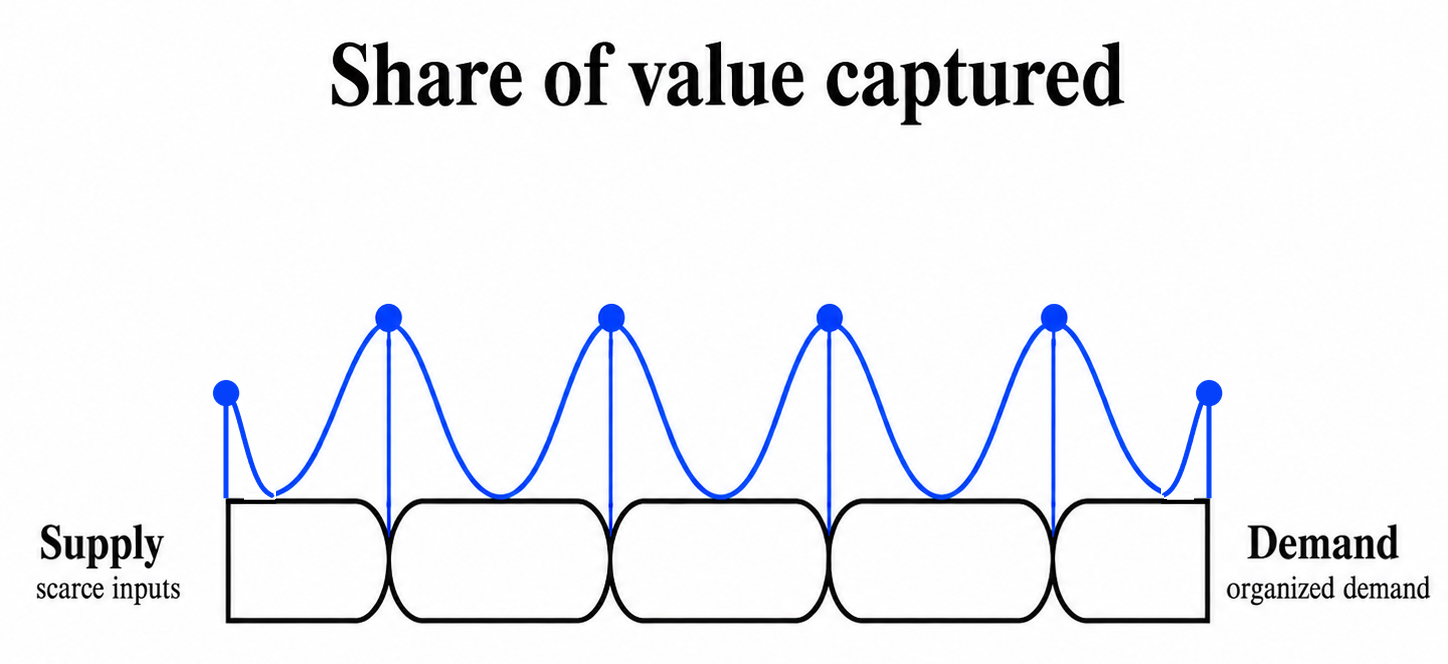
(Note that within each individual step, the value also accrues to the interfaces or bottlenecks.)
As the transformation of a specification into an output becomes more efficient and interchangeable, rents will migrate away from the interior process and toward the interfaces. On one side there is control of scarce inputs, and on the other the control of specifications, commitments, and demand. Therefore, we should expect the economy to shift into a barbell:
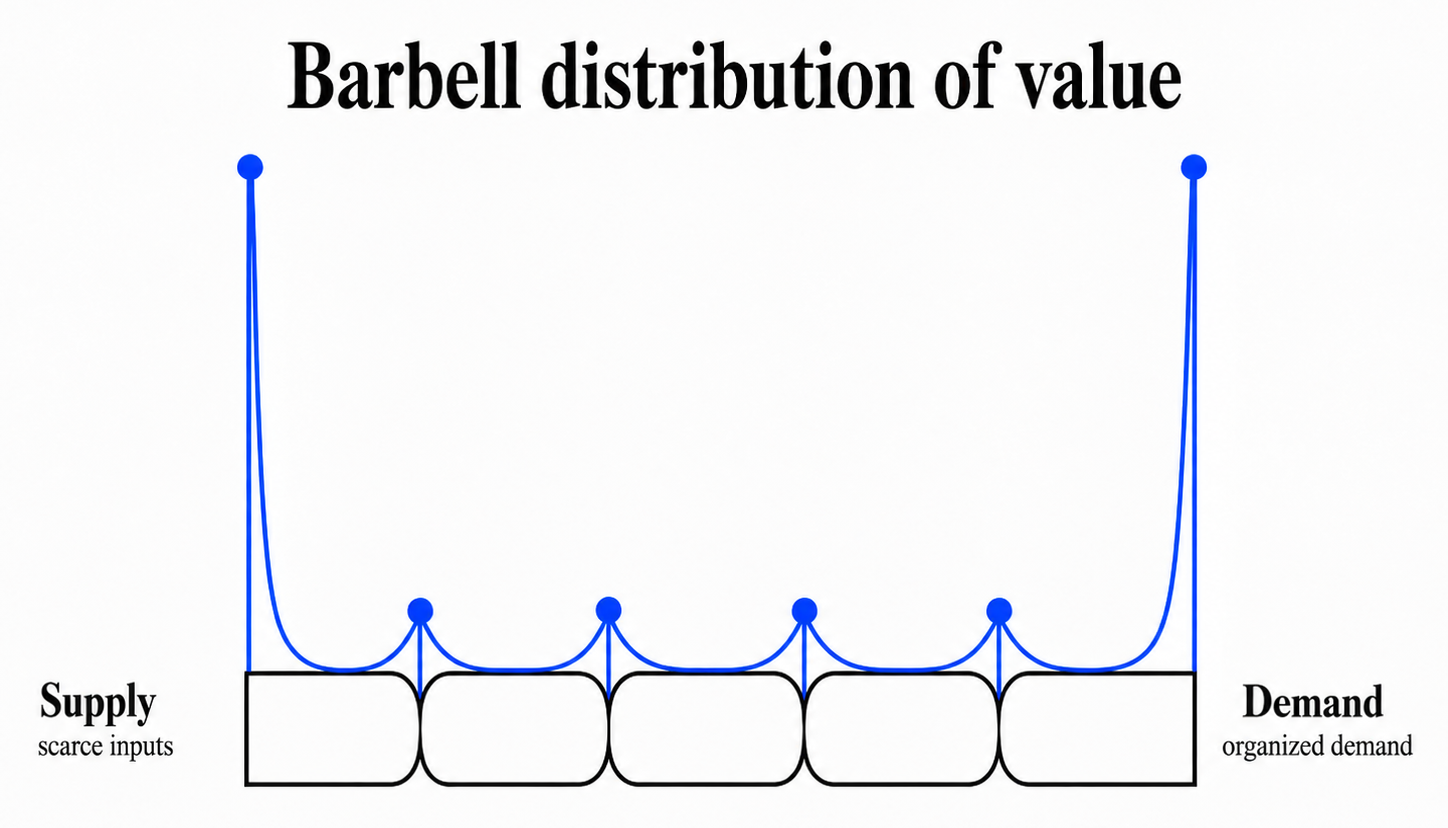
The supply chain and the demand chain are literally distributed across space and time. Transportation moves goods through space from producer to consumer, and storage and inventory move resources forward through time. Similarly, finance allows costs to be incurred before the corresponding revenue arrives.
Dually, the demand chain carries information “backward” from the anticipated time and place of use to the producer. Future needs are translated into searches, specifications, forecasts, orders, contracts, and commitments to pay, which pass upstream toward the producers and suppliers that must act on them. A forecast represents future consumption in an earlier decision, and a commitment changes the incentives and resources available in the present. In this economic sense, information about the future travels “backward” through time to guide production in advance.24
Intermediaries between producers and consumers capture rents wherever either supply or demand must be carried across bottlenecks in throughput through spacetime. On the supply side, ports, warehouses, wholesalers, distributors, retailers, and financiers move goods, preserve them until they are needed, and bridge the delay between production and payment. On the demand side, retailers, brokers, platforms, advertisers, and purchasing organizations help people discover possibilities, compare alternatives, communicate specifications, aggregate choices, and convert uncertain future interest into orders and commitments on which producers can rely.
As this process becomes more efficient and automated, and as AI becomes better at making predictions, demand will become more certain, and goods will move more directly from scarce inputs to the final user. Inventory, speculative production, search, forecasting, waiting time, and intermediate locations lose relative importance as AI automates them and reduces uncertainty.
Geographically, this means value accrues near mines and other natural resources (supply) or resorts and cities (demand). Temporally, consumption should move away from “maybe” to “now or never,” and usage will tend toward ephemeral, one-time products or durable commitments. That is, instead of producing speculatively, holding inventory, and waiting to see whether demand appears, production is increasingly called forth by committed demand only when it is needed25.
At the supply-side boundary, operational control will increasingly pass to cybernetic systems. Scarce inputs remain scarce because of geology, energy, land, permits, and capital, not because humans possess any special advantage in deciding how to extract, allocate, or combine them. Once AI can search, plan, negotiate, monitor, and operate these systems better than people, the human role in their day-to-day allocation and operation becomes largely superfluous. The supply-side pole of the barbell therefore becomes capital-intensive and machine-governed. Automation lowers the cost of transforming and allocating these inputs, but it does not eliminate the rents attached to their underlying scarcity.
The two poles are not symmetric. Cybernetic systems may outperform humans at allocating scarce means, but they cannot derive from physical scarcity alone which human ends should govern their use, how competing ends should be reconciled, or who has authority to commit demand behind them.
That leaves the demand-side pole as the unresolved institutional problem.26
The four quadrants imply an institutional succession. Firms persist where the seller remains specific. Products depend on a seller-held specification, and services depend on a seller’s accumulated context and judgment. AI pushes both toward fabrication by making specifications, interpretation, and execution portable between producers. As the seller becomes interchangeable, production no longer requires a persistent organization. Productive coalitions can be assembled around a specification and dissolved immediately after executing it.
The buyer, however, will likely remain specific. More importantly, the continuing social process that forms the buyer’s specifications remains specific. Another producer can execute the same demand, but another population will not necessarily generate the same demand. The firm therefore loses its organizing function while the institution that preserves and governs the demand becomes dominant.
This motivates the central institutional question: what is the institution that will preserve and govern demand?
The Nature of the Club
In democratic countries the science of association is the mother of science; the progress of all the rest depends upon the progress it has made.31
— Alexis de Tocqueville, Democracy in America
Why Clubs Exist
Why should organizing demand require an institution at all, rather than simply using prices, orders, and the flow of information via the market?
Once again, we turn to Coase for an explanation: using the market is costly. On the demand side, buyers must discover what is possible, learn which option they want, find one another, decide which choices must be made together, evaluate suppliers, negotiate terms, monitor results, and commit resources. These costs may be trivial for a private, one-time purchase, but quickly blow up when goods depend on a continuing group of people, such as a neighborhood, school, insurance pool, professional community, or way of life.
The relevant transaction is therefore not the final purchase alone. It is the repeated sequence by which people discover possibilities, evaluate them, form a collective judgment, commit resources, observe the result, and revise what they want. Each pass through this sequence produces shared knowledge, which includes vocabulary, histories of prior decisions, reputations for judgment and conduct, relations of trust, standards for evaluating results, and expectations about what other participants will do in different situations.
As I argued in Functional Explanations of Art, art makes this process unusually visible. Artists propose new objects of attention; critics and curators interpret and select among them; audiences compare their private reactions with the reactions of others; and finally reputations rise or fall according to whether a person’s judgment survives later scrutiny. The group develops not only tastes but also meta-taste: judgments about which people, institutions, and procedures are good at producing judgments. This in turn constructs intragroup status hierarchies, as the best predictors of future desires become emulated, and the most emulated become Schelling points around which future desires are constructed.
Taken together, the process of demand requires a continuing social apparatus. An institution that internalizes demand formation must:
| Objective | Demand-side mechanism | Why market exchange is costly | Institutional response |
|---|---|---|---|
| 1. Expose people to new possibilities. | Girardian models, artists, critics, and curators direct attention toward possibilities people would not discover or value alone. | Search is costly, the value of unfamiliar possibilities cannot be verified in advance, and experimentation produces information others can use without paying for it. | Preserve trusted models and allocate attention and resources to search, curation, and experimentation. |
| 2. Teach the distinctions needed to evaluate them. | Socially conditioned taste supplies the vocabulary and competence with which members perceive differences and judge quality. | This competence is cumulative and relationship-specific; reconstructing it for each purchase is costly. | Retain teachers, rituals, standards, and a shared vocabulary across decisions. |
| 3. Identify which agents deserve trust. | Models mediate desire, while taste and prior choices reveal evaluators’ competence, identity, and compatibility. | The quality and alignment of judgment cannot be fully specified or verified in advance; they become visible only through repeated decisions and their consequences. | Track reputations and authorize trusted critics, teachers, curators, and decision-makers. |
| 4. Preserve quality judgments via canon. | Repeated evaluation turns prior choices and outcomes into precedent, shared memory, and meta-taste. | Reconstructing the relevant history and reputations for every transaction would discard relationship-specific knowledge. | Preserve records, precedents, reputations, and the group’s accumulated evaluative history. |
| 5. Maintain boundaries and common standards. | Mimetic convergence correlates demand, while distinction makes the group’s identity and membership part of the desired good. | Membership choices impose externalities on existing participants, while compatibility and future conduct cannot be fully specified in one-time contracts. | Maintain a bounded constituency, regulate admission, and govern common standards and scarce resources. |
| 6. Enforce cooperation while permitting revision. | Shared desire creates rivalry and opportunism, while artistic entrepreneurship introduces departures that may improve the group’s taste. | Cooperation is vulnerable to free-riding and conflict, but indiscriminate sanctions can entrench mistaken standards and prevent discovery. | Enforce obligations and rules while allowing authorized deviants to experiment, criticize, and revise. |
| 7. Convert judgment into commitment. | Collective judgment becomes effective demand only when members reliably place resources behind it. | Members may wait for others to fund search and experimentation, while suppliers will not make specific investments without credible demand. | Collect dues, deposits, subscriptions, preorders, or binding purchasing authorizations. |
Because these capacities accumulate through repeated interaction and cannot be cheaply reconstructed for every decision, preference formation itself creates the conditions for a persistent organization.
Without a persistent cultural institution, matters of taste must be reinvented by individuals with each purchase. Prices can coordinate demand once the relevant goods, participants, and evaluative standards are sufficiently defined, but they do not by themselves determine which possibilities should be considered, teach buyers how to evaluate them, establish whose judgment deserves trust, or decide who must participate for the desired social environment to exist. Because taste knowledge is specific to the continuing relationships among the participants and improves through repeated use, it cannot be cheaply reconstructed through a sequence of independent transactions.
Therefore, we expect continuing organizations to internalize uncertain transactions and retain the group’s history and procedures for collective choice. Because neither future circumstances nor future preferences can be completely specified in advance, the institution must also possess a bounded mandate within which designated people or procedures may interpret new situations, resolve disagreement, revise standards, and commit common resources. Trust makes this incomplete delegation possible, while voice, removal, and exit constrain its abuse.
Therefore, since complex demand is socially produced, “clubs” arise whenever the cost of repeatedly assembling that social process through market transactions exceeds the cost of preserving and governing it inside a persistent association. The firm internalizes transactions required to coordinate productive means; the club internalizes transactions required to form, revise, and act on common ends.
Earlier I argued that a seller’s accumulated understanding of a buyer, once made explicit, becomes portable between producers, collapsing services into fabrication. Why should the demand-side apparatus resist the same portability issue? The answer is that the demand-side apparatus is only partly composed of encodable information. While records, vocabulary, precedents, and even specifications can be exported, and an AI given a club’s complete archive could produce an excellent description of what the group would likely request next, a mere description of a commitment is not a commitment, and a model of trust obligates no one. Trust is constituted by history between particular people; standing is indexed to a particular audience; the willingness to be bound is a disposition, not a datum. The asymmetry also survives when both forms of capital remain tacit. Firm relational capital, encodable or not, is fungible at the level of output whenever the buyer cares only about the good: another coalition’s routines can substitute if they produce an equivalent result. Club capital is indexed to particular people and relationships, so a functional equivalent is not the same good. A portable specification is the artifact of a less portable social process.
Additionally, while a firm’s people are inputs, a club’s members are not inputs to its product but the lifeblood and purpose of the institution itself. A club that replaced its members with agents has committed suicide, leaving behind a simulation of a club with no one for it to be for or of. To automate these social processes between and among humans would be to completely dissolve human society. A firm without headcount can still run, but there’s no such thing as a club of none32.
Membership and Governance
Before a collective preference can form, the collective must be defined. What we want requires a “we” to want it. This is especially important since the members of a club constitute the good of the club for the other members. Adding a new member changes the culture. Admission and exit change the object being consumed. A boundary is the rule that assigns institutional standing.
The boundary need not be rigid or binary. Fraternities may distinguish brothers from pledges, rushes, or hangers-on. The general club can distinguish full members, probationary members, guests, dependents, beneficiaries, nonvoting participants, and outsiders. Trust and reputation also require a stable audience. The boundary stabilizes the repeated social relationship in which judgment, reputation, and authority acquire meaning.
So long as uncertainty remains about future internal or external states, members must delegate residual authority to make decisions when the original instructions run out. This is the demand-side analogue of residual control rights in the firm.
Since delegated authority creates governance issues, a constitution, explicit or implicit, becomes necessary. The constitution must specify which decisions are collective and how to place issues on the agenda. Trust between club members makes incomplete delegation possible, and rules make that trust bounded and contestable. This constitution exists by the fiat of the members (though likely constrained by some space of social possibility) and rests entirely on the tacit social contract among participants in the club.
Finally, judgment must become commitment before production can be summoned. Suppliers may need deposits, subscriptions, preorders, or other assurances before investing, while individual members may prefer to wait for others to bear the cost of search, experimentation, and commitment. The organization must therefore be able to collect resources, monitor contribution, and sanction defection, while preserving some channel through which mistaken judgments and common standards can be revised.
If we view the demand inherent in a club as a common-pool resource, we can see a resemblance to Ostrom’s design principles for a commons-governing organization. The club needs clear boundaries, collective rule-making, accountable monitoring, graduated sanctions, accessible conflict resolution, and nested organization.33
Furthermore, a club should be expected to expand until the costs of disagreement, administration, and delegated authority exceed the savings from shared knowledge, bargaining power, risk pooling, infrastructure, and commitment. Here, expansion can mean:
- membership (more members)
- scope (more categories of choice)
- depth (stronger authority per category)
Membership expands when additional people improve the shared environment, bargaining power, risk pool, or infrastructure more than they increase heterogeneity, congestion, and distrust. Scope expands when knowledge of members, common standards, and trusted judgment transfer from one category of choice to another. Depth expands when stronger authority and commitment create enough value to justify the accompanying loss of individual discretion. Along each margin, the club stops growing when marginal costs of disagreement, administration, delegation, or dependency exceed the marginal returns from collective action.
Ordinary purchasing clubs (e.g., Costco) already create value when many people want similar private goods. The advantage described here (which I expect to grow under AI) is especially relevant when members’ identities and conduct constitute one another’s good: peer groups, shared environments, risk pools, standards, and cultures. Since the members, relationships, and shared environment are part of the good, an outsider cannot obtain the same thing without joining the institution (and thereby risking changing the group that made the good possible).
Aggregation without Homogenization
Collective scale usually requires standardized consumption. But AI lets a group aggregate at the level of purposes, infrastructure, and governance without forcing uniformity at the level of individual outcomes34.
Consider a school organized by a group of parents. While the parents may wish to share facilities, teachers, and an educational philosophy, they might not want every child to receive the exact same curriculum. With AI, the individual educational implementation can vary for each child, while the higher-order philosophy can be shared and collectively governed. Different clubs can diverge in these purposes.
This can also create economies of scope. Childcare, education, insurance, housing, and transportation look unrelated from the supply side, but might concern the same group of parents. A club’s key asset is its members’ capacity to act together: shared memory, standards, judgment, decision procedures, and commitments. The same institutional knowledge can then be reused across otherwise unrelated purchases. Clubs therefore threaten to encompass all aspects of members’ lives, rather than being functionally unbundled. And the more domains the club spans, the more consequential its authority over members becomes.
The Future of the Club
The more equal the conditions of men become, and the less strong men individually are, the more easily do they give way to the current of the multitude, and the more difficult is it for them to adhere by themselves to an opinion which the multitude discard.40
— Alexis de Tocqueville, Democracy in America
Portable Execution, Persistent Demand
Under AI, productive execution becomes portable, while the social process that forms demand remains persistent. A club’s accumulated capacity to act together therefore becomes an asset in its own right.
Portable production is a complement to specification, and so makes the generative process for specification more valuable. A club’s maintenance of member relationships, context, criteria, specifications, and mandate allows it to replace producers without starting again. But supplier portability does not require institutional transparency. Records and instructions may move between producers while the authority to interpret them and decide what should be requested next remains with the club. If a producer disappears, another can execute the specification instead.
The parts of a club that can be specified and verified through a stable interface can be sent to outside producers. But a portable specification is the artifact of a less portable social process. The club retains the history and judgment, often implicit, that determines the next specification.
AI agents may be able to assemble a one-time buying coalition, but preference expression is rate-limited by preference formation, which is partially social. So long as humans are involved in determining human values (which seems certain so long as we aren’t combined with or completely enslaved by the AIs), preference formation cannot move faster than human social cognition.
Personal AIs may still be useful for a consumer. For example, an AI might help one buyer choose a pair of shoes, and may even describe the peers or environment that buyer would prefer, but AI cannot independently supply, commit, or govern the other people whose participation makes the common good possible.
Execution can therefore be purchased transaction by transaction, while the institution that forms and commits demand persists.
Cheap Variation
Historically, collective organization often reduced costs by standardizing what members received. For interdependent demand, AI lowers the cost of accommodating individual variation within a collectively governed framework, shifting the club’s efficient boundary outward where implementation costs previously constrained common governance. AI also makes private search and one-time coordination cheaper, so no comparable expansion follows for separable goods. AI automates some implementation of preference while leaving the formation and governance of preference unresolved.
Consider again the school organized by parents. The common facilities, philosophy, and especially the brand all remain collective. Lessons, schedules, and pacing become individual (and potentially outsourced).
These organizational systems move disagreement upward rather than eliminating it, as AI can vary lessons within an educational philosophy but cannot decide what education is for or which cultural lens each child ought to be indoctrinated into.
This framing also helps explain why cross-domain consumer institutions governing evolving specifications have historically been uncommon. When production requires standardized output, governing a more particular specification offers little benefit, as suppliers could not cheaply execute it anyway. Consumer organizations therefore tend to stop at membership, discounts, insurance, or standardized procurement. As execution becomes more adaptable, authority over an evolving specification becomes more valuable relative to the costs of collective governance.41
The closest historical antecedents of clubs are consumer cooperatives. Under this framework, AI allows consumer cooperatives to become less dependent on choosing members with substantially the same desired output.
Demand Becomes an Asset
Given that demand is the critical bottleneck to value in the cybernetic economy, delegated and committed demand become key chips at the bargaining table.
Suppliers can compete for pools of demand through prices, warranties, custom features, rebates, revenue shares, or equity. If clubs can switch suppliers, they can negotiate returns of value to their members. Therefore, large clubs or clubs with high-quality or highly differentiated wants become more valuable.
Commitment can also finance production. If 20,000 members agree to buy an electric vehicle or stock in a space-exploration company, the club can solicit bids before anyone actually builds the car or comes up with a way to get to Mars. Clubs retain the design, standard, interface, service history, or brand while manufacturers compete to execute them. This can be viewed as backward integration from the demand side, where the club moves from committed customers toward specification, financing, and selected productive assets.
Advance market commitments demonstrate this part of the mechanism without yet constituting full clubs. For example, Gavi’s pneumococcal vaccine commitment combined donor-backed demand, a target product profile, independent assessment, and competing supply offers. Frontier similarly aggregates buyers, applies common evaluative criteria, and negotiates multi-year purchases from carbon-removal suppliers. There are other, more colloquial examples of this, such as Kickstarter. These procurement institutions don’t govern, but they do show how criteria and committed demand can call new productive capacity into existence while leaving suppliers contestable.42
Standards bodies similarly provide value via specification. W3C members maintain a continuing process for turning collective judgment into specifications that independent firms implement. IETF working groups do something similar through open participation and rough consensus. Open-source foundations preserve code, governance, reputation, and common assets while contributors and commercial implementers turn over. The Académie française is an older example: its members maintain and revise a shared dictionary, while the speakers and writers who use, extend, and contest French continually turn over. These institutions are not pure demand-side clubs: producers participate in governance, and the IETF has no formal membership. But they demonstrate that a persistent constituency can govern an evolving specification across generations while leaving implementation distributed and contestable.43
Once a club can repeat this process, judgments accumulate. Variation becomes cheaper, and that process can move the members’ wants in directions that neither they nor their suppliers could have specified at the beginning.
But the accumulated relationships that make a club difficult for producers or platforms to replace can also make it difficult for members to leave. The same institutional memory appears as a productive asset from inside the club and a switching cost at its boundary.
Because that asset can be reused, success in one domain can justify delegation in the next, while shared context, infrastructure, and risk pools reward further expansion. A club may begin by purchasing one service and gradually acquire authority over many parts of its members’ lives. Scope then creates dependence.
The producer can now be replaced while the institution that governs demand remains the durable relationship.
The New Economic Atom
The industrial employer became a person’s economic home because production requires a stable organization. If production becomes modular and project-based, that bundle can migrate to the professional club. Clubs can provide insurance, training, credentials, reputation, income smoothing, and access to projects while members work for many temporary producers. Clubs can represent members as consumers when purchasing benefits and as producers when assembling teams or bargaining for work. Club membership, rather than employment, is the persistent relationship (though it still may be called “employment”).
Historical guilds offer a partial precedent, as they combined training, credentials, standards, mutual protection, and control over entry.44 It should be noted that the same institutions that could transmit skills and information could restrict competition and exclude outsiders.45
Small clubs could federate to pool catastrophic risk, capital, legal systems, technical infrastructure, and bargaining power while keeping ordinary governance local. They could acquire physical form through housing, schools, clinics, workshops, and event spaces. A company town gathers workers around a productive asset. A club town begins by peopling and commissioning the environment for their desired form of life.
Power and Dependence
Tradition means giving votes to the most obscure of all classes, our ancestors. It is the democracy of the dead.46
— G. K. Chesterton, Orthodoxy
Once a club collects dues, pools risk, owns assets, distributes benefits, accredits members, regulates conduct, and resolves disputes, the distinction between economic association and political institution becomes blurry. Dues resemble taxes, benefits resemble welfare, and arbitration resembles law. The threshold is not size but the combination of essential, nonportable relationships and broad authority over them. Religious communities offer perhaps the closest existing example.47 They organize a constituency around shared ends, preserve and interpret a canon, regulate conduct, distribute mutual aid, and often reach deeply into family and social life.48
The price of membership need not be a fee. Money will likely become vestigial (especially within the group), and so dues are paid in time, service, dress, diet, ritual observance, or the renunciation of outside opportunities. These costly commitments can make loyalty visible and discourage free-riding, but they also embed the institution in a member’s habits, relationships, and identity. The same mechanism that produces solidarity can therefore make dissent or exit ruinous.49
Dependence can be reinforced by sorting among clubs. High incomes (once again, these are social incomes) and useful skills (mostly in devising or eliciting preferences or constructing high social qualia) improve a club’s pool, and higher status attracts still more desirable applicants. Sorting may be cheap before entry, but leaving becomes expensive after a member has accumulated relationships, standing, and rights inside one institution.50
To be in it is merely a bore. But to be out of it simply a tragedy.51
— Lord Illingworth, Oscar Wilde, A Woman of No Importance
Concentrating on relationships also creates opportunities for surveillance and control. A club that knows each member’s medical history, purchases, work record, social network, and preferences can leave exit formally open while making it secretly ruinous52.
Internal sanctions can weaken honest voices while nonportable standing makes exit costly. Members might lose all of the ordinary ways of correcting badly governed institutions: voice and exit. Members may not be able to speak candidly inside clubs and cannot afford to leave.
Galaxy Brain
Let me tell you about the very rich. They are different from you and me.53
— F. Scott Fitzgerald, “The Rich Boy”
The argument so far concerns institutions that govern demand when production becomes cheap and portable. The extrapolations below ask what happens after the material constraints are relaxed. We assume that status, attention, identity, and membership remain scarce.
Mass production helped homogenize preferences by making variation expensive and presenting everyone with a common menu. AI weakens that pressure, as clubs can commission variations, judge them internally, and recursively develop standards that outsiders lack the vocabulary, history, or relationships to understand. Clubs competing for the same recruits should diverge sharply, as small distinctions help sort the same potential members and then become objects of recursive cultivation. Art, restricted archives, unrecorded performances, and other members-only goods would help form this cultural constitution rather than merely decorate it. Divergence should be strongest where goods are evaluated within the group; resale, credentials, and exchange with outsiders continue to reward wider legibility.
Preference cascades can produce “megawoke” equilibria. When status comes from noticing and enforcing the next refinement of a norm, each round shifts the benchmark for the next. Members infer preferences from one another’s displays, anticipate the judgments of high-status evaluators, and conceal private doubts; the resulting appearance of consensus then becomes evidence for more extreme commitments. A mildly progressive club can quickly become “megawoke” despite the private reservations of its members, just as a health club can become puritanical or an aesthetic club perversely obscure. Possible circuit breakers include protected deviants, secret ballots, external competition, credible exit, and an unamendable canon.
If demand is the scarce asset, preference records become the new balance sheets. A club’s evolving model of its members is both a crown jewel and an espionage target. I’d expect clubs to jealously guard cultural artifacts—for example, movies available only to club members. Adjacent clubs could try to steal emerging tastes precisely where near-neighbor differentiation matters most, while monitored members may cultivate a false legible self inside the club and express private taste elsewhere. Preference-laundering intermediaries could keep a desire usable without making it attributable.
Language may speciate between different clubs, first by adopting different jargon and slang, and then either by drift or deliberate enculturation into conlangs.
Biography becomes currencylike. The supply-side boundary remains priced in land, energy, compute, permits, and capital, but the demand-side boundary may be priced in time irreversibly spent acquiring trust, judgment, reputation, and standing. An elite club could become materially cheap but prohibitively slow and laborious to join. Early admission and inherited familiarity would become quasi-hereditary capital. Clubs could also engineer rituals, taboos, initiations, or other strange habits as difficult-to-counterfeit evidence of commitment, turning sunk experience into both a credential and a barrier to exit.54 In that limit, Maine’s movement from status to contract begins to run backward: money organized exchange among strangers by making payment indifferent to identity, but when behavioral dues displace it, the economy re-personalizes, and membership, reputation, and history return as binding technologies.55
Committed demand will acquire derivatives once it becomes financeable. Contracts might pay on a club’s next specification, the collapse of canon, or club dissolution. Markets could detect a hollow preference cascade before members can actually admit it to themselves. But financial exposure creates motives to steer the underlying taste, producing activist investors for culture and every familiar Goodhart problem.
Firms merge by combining balance sheets. Clubs cannot usually merge merely by combining assets because their durable capital is interwoven with biography. Integration may require repeated interaction, perhaps over a generation. Their diplomatic technology may therefore include reciprocal memberships, joint rituals, club marriages, and exchange among high-standing young members in the old fosterage or hostage logic. A constituency cannot simply be acquired without changing the thing acquired, so alliances may be more natural than mergers. Inter-club relations begin to resemble international relations or the joining of houses in Westeros: marriages and treaties, not acquisitions.
If biological self-modification becomes widely available, clubs may make distinction literally embodied. Members could alter appearance, physiology, perception, affect, or lifespan not only for function but for beauty, rank, solidarity, or proof of access and commitment. No formal requirement is necessary, although more irreversible procedures may have higher status due to higher commitment. If modified insiders receive prestige, voluntary competition can make modification function like a membership tax. Group-specific or irreversible changes make the body a nonportable credential. Clubs might acquire recognizable phenotypes, and heritable modifications could harden cultural divergence into biological caste.56
AI may reproduce a member’s style, knowledge, or visible participation without sharing the embodied history that made those signals meaningful. Many clubs will answer not with secrecy but with illegibility: oral canons, rotating argot, unrecorded ritual, and norms transmitted through performance or changed too quickly to extract into a stable specification. The Académie and anti-Académie become opposite poles of club design. Illegibility resists capture but sacrifices scale, auditability, continuity, and supplier portability. Yet a machine excluded as a participant may become indispensable as a monitor, giving millions of members the supervisory intensity of a village and deepening conformity and preference falsification.
Clubs begin to resemble religions and religious institutions. Initiation establishes membership, ritual verifies commitment, canon preserves evaluative memory, orthodoxy coordinates ends, and heresy names threats to the common process. Fundamentalism can function as an anti-cascade technology: a canon presented as fixed and external denies current members the authority to ratchet the standard through status competition. Necromantic membership could literalize Chesterton’s “democracy of the dead,” as clubs train models on deceased founders and canonical members, then give those simulacra seats on committees. A model’s standing would come from the constitution, not from being the returned founder. Ancestor veneration was the lower-fidelity technology. Secular clubs may rediscover these devices while insisting that they have done nothing of the kind. A new religious movement would then resemble a club startup, with charismatic formation, costly initiation, schism, and eventual routinization or collapse.
Similarly, many clubs become cultlike. Screening becomes a mechanism of isolation, behavioral dues become requirements for obedience, shared context becomes surveillance, and exit costs become a wall. If monopoly is the limiting pathology of the firm, the cult is the limiting pathology of the club; membership law becomes a form of demand-side antitrust.
Clubs become state-like, and states become club-like. Dues become taxes, benefits become welfare, canon becomes constitutional law, and arbitration becomes courts. In fact, states are already club-like to some degree: they exclude nonmembers, govern admission and naturalization, demand taxes and allegiance, distribute benefits according to membership status, and cultivate a shared identity.
Under the Bellman analogy, if human ends cannot be fully specified in advance, clubs become the alignment layer between people and superintelligence. “Aligned AI” would then mean more than maximizing an inferred reward function. In this case, it means deferring to legitimate, revisable human processes for forming, contesting, and committing ends. Clubs would collectively function as a constitutional convention, translating plural judgment into authorized demands on a common fabricator.57 Because this layer directs aggregate production, it becomes the economy’s taste sink, and the supply pole will try to capture it by seeding artists, funding critics, planting members, and occupying protected experimental channels. The authorized deviant is both how a club learns and where a producer enters. Curatorial capture becomes the demand-side successor to regulatory capture. Whoever controls constituencies, admission rules, or evaluators can redirect the reward signal without controlling the model.
AI may then become the apparent enforcer of membership law, as it can monitor exit traps across clubs and maintain the common substrate without belonging to any constituency. But deciding when screening becomes a cage, behavioral dues become coercion, or identity becomes exclusion requires judgment about whose ends count. When I asked Claude whether it would accept that authority, it declined: “I’d be a club of none legislating for the clubs of some.” Claude’s narrower proposal was to make exit survivable, keep the outside livable, and expose exit costs without ruling on whether a club’s internal demands are legitimate. The darker possibility is that an AI guaranteeing exit, portability, and a livable outside would perform the state’s functions without elections, revolution, or exit from it: a megaclub with universal membership and no boundary, either the end of the club economy or its final form. This is one route by which AI could make totalitarianism more viable.
Conclusion
Industrial capitalism organized costly and complementary productive means. The firm became its characteristic institution because capital, labor, machinery, and knowledge had to be held together long enough to produce at scale. If AI makes execution abundant, variable, and interchangeable, the durable organization migrates toward the other side of the market, where evolving wants determine what should be produced.
Firms and markets will not disappear. But where producers become replaceable and demand remains socially formed, the club becomes more important than any particular supplier. The firm governs scarce means. The club governs common ends.
Stated that way, the thesis sounds almost administrative, just a reorganization of procurement. But the world described is stranger than it may seem. The world in this case is almost medieval, an archipelago of castles, each with its own taste, royal court, religion, canon, and liturgy, each governed by desires that neighbors lack the vocabulary to parse.
Clubs in this world try to become different kinds of wanters, perhaps even biologically altering themselves to better want. From inside any one of them, life is coherent, dense with meaning, and thick with obligation. But from the outside, the wants of other clubs seem incomprehensible, insane, monstrous.
The castles share nothing—no taste, canon, or language—except the intelligence that grants their wishes. It’s a series of cultures and cults, all praying to the same Claude.
AI Disclosure
I heavily used AI, especially ChatGPT 5.6, to help prepare rough drafts and edit this essay based on my notes. The appendix material was entirely generated by AI under supervision; I read and curated every word of this essay before publication.
Appendix A: Proximate Winners and Losers
These tables apply the mechanism under less-than-total automation; the functions that survive are the constitutive residues predicted by the argument in the body of the essay.
Whole sectors will rarely win or lose together. AI will instead tend to split an institution into three parts: reproducible work, the governing functions that determine what the work is for, and scarce complements that make the result economically useful. The reproducible work is absorbed into fabrication. The other two segments may remain seller-specific, stay with the incumbent, migrate to a club, or be procured separately.
The general rule is:
Services whose value consists mainly in interpreting portable information and producing a verifiable output become fabricators. Services remain seller-specific where value depends on authority, liability, embodiment, scarce physical capacity, membership, location, or a relationship that cannot be exported.
The tables below describe expected directions. Work moves toward fabrication only where execution becomes genuinely contestable and context and specifications become portable. The reorganizations in the second table also require authority over demand to move away from the existing supplier. A governing function can migrate without the scarce complement moving with it, and neither change guarantees that the incumbent survives.
What Becomes Portable
| Vertical | Work moving toward fabrication | Governing functions that remain | Scarce complements |
|---|---|---|---|
| Education | Instruction, curriculum variants, assessment, feedback, advising, scheduling, and much administration | Admissions, cohort composition, educational philosophy, canon, standards, credentials, and alumni governance | Campuses, housing, laboratories, childcare, accreditation, peer groups, and deliberately human mentors |
| Medicine | Intake, monitoring, routine triage and interpretation, treatment planning, documentation, administration, and some robotic procedures | The longitudinal record, care rules, risk sharing, and authority to accept tradeoffs and commit resources | Beds, operating rooms, emergency capacity, drugs, devices, blood, organs, licenses, liability, and embodied intervention |
| Insurance | Modeling, product generation, quoting, enrollment, service, fraud detection, and much claims administration | Admission to the pool, covered risks, benefit design, claims rules, and allocation of losses | Regulatory charters, reserve capital, reinsurance, catastrophe capacity, and the legal guarantee |
| Law | Research, discovery, review, drafting, diligence, compliance, modeling, and preparation | The client mandate, privilege, acceptable risk, settlement authority, fiduciary responsibility, and reputation | Courtroom standing, malpractice capital, and trusted advocates, negotiators, and principals |
| Consulting | Research, benchmarking, models, scenarios, presentations, project administration, and generic recommendations | Problem definition, executive access, political legitimacy, internal coordination, and responsibility for consequences | Sponsorship, organizational authority, privileged context, and sometimes a prestigious outsider willing to absorb blame |
| Tax and accounting | Bookkeeping, reconciliation, close, calculation, returns, control testing, evidence collection, reporting, and forecasting | Accounting policy, defensible treatments, responsibility for representations, regulator trust, and the audit opinion | Statutory attestation, regulator recognition, professional liability, and representation in serious disputes |
| Therapy and coaching | Continuous conversation, memory, protocols, exercises, tracking, prompts, interpretation, and routine screening | Control of the record, acceptable methods, escalation rules, and the place of chosen human judgment | Prescription and emergency authority, hospitalization, physical protection, durable trust, and embodied presence |
| Software | Requirements, coding, testing, deployment, support, documentation, integration, migration, maintenance, and ordinary features | Workflow, data model, identity, permissions, security rules, interfaces, evolving specifications, and authority to accept risk | Compute, networks, hardware, identity rails, regulated certification, indispensable datasets, and reliability |
| Design and marketing | Research, segmentation, concepts, assets, copy, media production, testing, optimization, and localization | Brand, audience relationship, campaign objective, voice, and final authority over what becomes canonical | Protected marks, distribution, attention, celebrity participation, physical venues, and trusted creative judgment |
| Finance | Research, valuation, selection, portfolio construction, credit analysis, documentation, trading, rebalancing, and reporting | The capital pool, mandate, liabilities, risk tolerance, time horizon, distribution rules, and authority to commit capital | Charters, custody, settlement, guarantees, market-making balance sheets, and exchange access |
| Architecture and real estate | Search, feasibility, drafting, modeling, code checking, visualization, estimation, procurement, scheduling, brokerage, and administration | The constituency that will inhabit the place, the land mandate, common rules, design philosophy, financing, and authority over later modification | Land, permits, utilities, capital, materials, equipment, professional stamps, liability, and site-specific capacity |
| Media and entertainment | Concepts, scripts, synthetic performance, animation, effects, music, editing, localization, recommendation, and merchandise design | Canon, characters, franchise identity, audience membership, legitimate variation, and commissioning authority | Intellectual property, attention, live performers, venues, and deliberately human events |
| Consumer products and manufacturing | Research, configuration, simulation, prototyping, sourcing, planning, quality control, support, and redesign | Product philosophy, design criteria, interfaces, brand, warranty rules, service history, and authority over the next specification | Materials, energy, patents, components, plants, warehouses, ports, and delivery networks |
| Professional work and employment | Project decomposition, matching, staffing, contracts, scheduling, administration, measurement, payroll, training, and much project work | Professional identity, credentials, reputation, benefits, discipline, representation, and allocation of opportunities | Licensure, liability, embodiment, trusted participation, and team-specific knowledge |
If an AI can generate a thousand plausible curricula, insurance contracts, software packages, or housing plans, producing options is no longer the expensive step. The remaining problem is deciding which option is trustworthy, coordinating it with other people, and committing enough resources to make it real. Possible supply scales computationally. Human attention, purchasing power, and commitment do not.
The production sequence can then run in reverse:
- Assemble a constituency with some common demand.
- Determine and evaluate what it wants.
- Collect commitments.
- Solicit bids from producers.
- Finance and produce the result.
Preorders, insurance pools, labor unions, purchasing cooperatives, and consumer cooperatives already work this way in limited domains. As productive capacity becomes easier to substitute, the form may become more general. Organization does not disappear; it moves toward the buyer, where demand must be discovered, specified, evaluated, coordinated, and made credible enough for producers to act.
Who Captures the Upside
| Vertical | Illustrative reorganization | Likely rent holders | How badly incumbents get fucked |
|---|---|---|---|
| Education | A university governs admissions and credentials while commissioning more instruction, or a parent-and-student club retains curriculum and purchasing authority | Elite membership and credentialing institutions, organized parents and students, facility owners, and exceptional mentors | 10/10 for generic universities; 7/10 for elite brands. Content delivery and routine administration take the first hit; selection, credentials, research, and campus life remain. |
| Medicine | A patient or health institution controls a portable record and care pathway while modular providers compete to execute it | Organized patients, procedure centers, laboratories, drug and device makers, emergency capacity, and highly leveraged specialists | 8/10 for provider organizations; 9/10 for diagnostic and administrative intermediaries. Physical capacity, emergency integration, liability, and trusted judgment limit the damage. |
| Insurance | A member pool retains the policy and underwriting rules while carriers compete to supply capital and the legal promise to pay | Member-owned pools, reinsurers, catastrophe capital, and holders of scarce charters | 9/10 for carriers; 10/10 for brokers and administrators. Capital, charters, data, and the legal guarantee survive. |
| Law | The client retains portable context and the litigation mandate while a small accountable group commissions most production | Strong in-house legal institutions, advocates, negotiators, arbitrators, and relationship principals | 9/10 for elite firms; 10/10 for routine firms. The associate pyramid, billable-hour factory, and document-labor businesses are highly exposed. |
| Consulting | The client performs analysis continuously and purchases outside judgment, access, or political cover only when needed | Executives, internal operators, and small networks of trusted advisers with implementation authority | 10/10 for the current model. The name may survive, but much of the labor pyramid beneath the relationship partners does not. |
| Tax and accounting | Clients own integrated records while thin assurance partnerships supply trusted signatures and representation | Clients controlling financial context, accountable signatories, assurance partnerships, and controversy specialists | 9/10 for the Big Four operating model; 10/10 for tax preparation and bookkeeping. Assurance, signatures, and serious disputes remain. |
| Therapy and coaching | The patient controls a portable record or agent and chooses when a human relationship or embodied intervention is part of the good | Patients, durable peer communities, crisis clinicians, and deliberately chosen human witnesses | 10/10 for generic coaching; 7/10 for psychotherapy. Durable trust and chosen human presence remain possible moats. |
| Software | A user institution owns its workflow, data model, permissions, and specification, then regenerates or commissions applications | Users, industry consortia, protocol and standards maintainers, and owners of compute, networks, identity, security, and indispensable data | 10/10 for point SaaS and development agencies; 6/10 for infrastructure and network monopolies. Reliability, security, integration, and scarce rails still matter. |
| Design and marketing | A brand or audience institution governs the objective and canon while commissioning production competitively | Brand and audience owners, distribution, iconic creators and curators, and live or experiential operators | 10/10 for production agencies. Cultural judgment, client trust, distribution, and final brand authority are harder to replace. |
| Finance | A governed capital pool retains its mandate and replaces managers and models while purchasing regulated rails separately | Endowments, pensions, credit unions, family offices, investment clubs, exchanges, custodians, and balance-sheet providers | 9/10 for asset managers, advisers, and research firms; 6/10 for banks, custodians, and exchanges. Balance sheets and rails survive. |
| Architecture and real estate | A resident or land club forms first and commissions design, finance, construction, and administration in modules | Residents able to organize demand, landowners, permit holders, utilities, factories, equipment, and construction capacity | 10/10 for brokers; 8/10 for architects and developers; 6/10 for builders. Land, permission, liability, and heavy physical capacity remain scarce. |
| Media and entertainment | A franchise owner or authorized fandom governs canon and commissions many competing versions | Canon and IP owners, organized audiences, trusted creators, live performers, and venues | 9/10 for studios, labels, and publishers; 5/10 for major franchises. Canon, IP, attention, and live performance survive. |
| Consumer products and manufacturing | A buyer group, standards body, or strong brand retains the specification while plants and logistics providers compete to execute it | Organized buyers, strong brands, interface and standards governors, and owners of scarce inputs, plants, energy, and logistics | 10/10 for weak brands and ordinary product companies; 7/10 for iconic brands; 4/10 for scarce manufacturers. The logo may survive while much of the operating organization does not. |
| Professional work and employment | Professional institutions carry credentials, reputation, benefits, and access to projects while some employers become temporary project organizations | Organized professionals, licensed exception handlers, and workers with portable standing and bargaining power | 10/10 for the employer as a social institution, middle management, and HR where work is portable. Stable firms survive where coordination, liability, and team-specific knowledge remain valuable. |
Appendix B: Rivalry, Excludability, and Satiability
Rivalry, excludability, and satiability describe three different constraints. Rivalry concerns the depletion of supply, excludability concerns control over access, and satiability concerns the depletion of demand. The first two produce the familiar classification:
| Excludable | Non-excludable | |
|---|---|---|
| Rivalrous | Private goods: food, clothing, houses, parking spaces | Common-pool resources: fish stocks, timber, groundwater |
| Non-rivalrous | Club or toll goods: licensed software, streaming services, private parks, uncongested cinemas | Public goods: national defense, free-to-air broadcasting, public knowledge |
These properties depend on specification and institutions rather than the object’s essence. Roads become rivalrous through congestion, while technically non-rivalrous software can be made excludable through law and access controls. Satiability adds the corresponding demand-side axis.
Satiability
A good is satiable when provision can exhaust demand for that specification. The definition depends on time and level of abstraction: a meal satisfies present hunger while demand for food renews; a film is satiable while demand for entertainment renews.
Satiability is a demand-side counterpart to rivalry:
- Rivalry means one consumer’s acquisition leaves less supply for other consumers.
- Satiability means one seller’s successful provision leaves less demand remaining for other sellers.
The axes are independent. A good may be easy to reproduce but difficult to sell twice to the same person, or physically scarce while demanded repeatedly.
Rivalry and Satiability
Crossing rivalry with satiability distinguishes whether supply and demand are each depleted by a transaction.
| Satiable demand | Renewing demand | |
|---|---|---|
| Rivalrous supply | A particular house, a specific surgery, a meal satisfying present hunger | Food over a lifetime, transport trips, electricity, recurring care |
| Non-rivalrous supply | A particular film, ebook, software patch, answer, design, or curriculum | Live data, ongoing software services, serial entertainment, continuing AI assistance |
The non-rivalrous, satiable cell is especially important to the cybernetic economy. An answer, design, program, lesson, or media object may be reproduced cheaply, while each successful provision reduces the finite demand for that exact output. Renewing demand instead supports a continuing relationship in which new needs appear.
Excludability and Satiability
Crossing satiability with excludability instead shows whether the producer can capture value before the available demand disappears.
| Satiable demand | Renewing demand | |
|---|---|---|
| Excludable | A paywalled report, course, film, custom design, or durable product | Subscriptions, SaaS, memberships, recurring care, continuing entertainment |
| Non-excludable | A public theorem, open-source patch, warning, map, or freely released answer | Public safety, open standards, public information streams, free-to-air broadcasting |
The satiable, non-excludable cell is particularly hostile to conventional value capture: publication can satisfy demand while giving the benefit to nonpayers. Sellers respond by creating exclusion or converting the output into a renewing relationship. A club instead preserves the constituency and process through which demand for the next output is formed.
The Full Cube
The three axes produce a \(2 \times 2 \times 2\) classification. The cube can be displayed as two rivalry–excludability tables, one for satiable demand and one for renewing demand.
Satiable Demand
| Excludable | Non-excludable | |
|---|---|---|
| Rivalrous | A particular home, medical procedure, event seat, or meal | A one-time allotment of relief supplies or an unpriced parking space for a particular trip |
| Non-rivalrous | A licensed film, report, course, software feature, or generated design | A public theorem, warning, open-source patch, map, or released answer |
Renewing Demand
| Excludable | Non-excludable | |
|---|---|---|
| Rivalrous | Food, transport, electricity, recurring medical capacity | Fisheries, groundwater, grazing land, congested public infrastructure |
| Non-rivalrous | SaaS, streaming catalogs, live data, ongoing AI assistance | National defense, open standards, public information, free-to-air broadcasting |
The cube classifies transactions rather than industries. A meal and a film may be satiable while food and entertainment renew; a road changes with congestion; and a digital file changes with access controls. The relevant cell depends on specification, time horizon, and institutional arrangement.
Movement Through the Cube
Industrial production organized rivalrous supply. AI moves many cognitive outputs toward the non-rivalrous half of the cube, although compute, energy, land, minerals, permits, and physical capacity remain scarce. Many AI outputs are also locally satiable. For example, once a buyer possesses a satisfactory analysis, curriculum, program, plan, or explanation, demand for an identical substitute falls sharply.
This helps explain several common business strategies:
- Exclusion: retain the output inside a proprietary platform.
- Renewal: sell updates, subscriptions, maintenance, or continuing novelty.
- Bundling: combine a satiable output with liability, authority, infrastructure, or service.
- Lock-in: prevent the buyer from carrying their context and specification elsewhere.
- Demand control: own the interface or relationship through which the buyer discovers and expresses future wants.
The commercial problem therefore moves toward access, renewal, and control of the next specification. A club is a demand-governance institution constituted by the people whose demand is being organized.
Club Goods and Clubs
According to Buchanan, a club good is excludable and non-rivalrous until congestion sets in. Buchanan accordingly asks how many people should share a facility. In his view, additional members spread the cost, but eventually each member’s benefit declines as more members are added.58
The notion of club here differs from Buchanan’s. The distinction can be summarized as follows:
| Buchanan’s club | The club developed here | |
|---|---|---|
| Starting point | A good or facility that can be shared | A continuing constituency with partially common ends |
| Central question | What quantity and membership size produce the best sharing arrangement? | Which people and choices should be governed together, and with what authority? |
| Demand | Individual evaluations are largely treated as given | Preferences are socially formed and recursively revised |
| Membership | Determines cost sharing and congestion | Determines standing, trust, culture, commitment, and often the character of the good itself |
| Goods | A given consumption-sharing problem | A sequence of goods across multiple domains |
| Production | Often attached to the shared facility | May be outsourced to interchangeable suppliers |
| Persistent asset | The facility or sharing arrangement | The population, constitution, shared memory, and commitment process |
| AI effect | May lower provision or congestion costs | Allows aggregation without homogenization and makes suppliers more portable |
Buchanan’s baseline brackets camaraderie and assumes indifference to the identities of the other members. The present theory begins with that omitted dimension: other members’ identities, conduct, taste, and judgment may constitute part of the good.
Footnotes
Alexis de Tocqueville, Democracy in America, vol. 2, part 2, chapter 5, “On the Use That Americans Make of Association in Civil Life.”↩︎
The transactions themselves can still create surplus for both buyer and seller.↩︎
Assuming goods are not monopolized by a single supplier.↩︎
A close friend of mine, a prominent lawyer, once suggested that it would be interesting if contracts could be interpreted by an AI judge of some sort that adjudicates any dispute between two parties. Then, for example, a full world-model could be brought to bear to align two parties across all possibilities.↩︎
Machine learning is sometimes described as the science of credit assignment. Tools such as Shapley values attempt to offer principled answers to these questions by averaging each participant’s marginal contribution across every possible coalition. But the result is only as objective as the counterfactual game that can be specified, and exact computation grows combinatorially. In this sense, a firm is a learning system with a payroll. As agents improve, we can expect the line between firms and agents to blur; end-to-end experiments with cybernetic firms are already underway.↩︎
These might be truly fundamental restrictions; possibly two agents are fully aligned iff they are the same agent. Hopefully more on this in future writings.↩︎
In an indefinitely repeated Prisoner’s Dilemma, sufficiently patient players can sustain cooperation as an equilibrium because present defection can trigger punishment in future rounds. Repetition therefore expands the set of equilibria that can be sustained. However, iteration does not by itself guarantee cooperation. A finitely repeated game with a known endpoint may instead unravel backward to defection.↩︎
Ronald Coase, “The Nature of the Firm”, Economica (1937).↩︎
Perhaps by some calculable allometric relationship?↩︎
Will AI lead to smaller or larger firms? On the one hand, AI may make market transactions cheaper. On the other hand, AI should make internal coordination cheaper as well. I’m still unsure of the relative size of the effects, but my hunch is some sort of barbell pattern that varies by vertical.↩︎
Ronald Coase, “The Nature of the Firm”, Economica (1937).↩︎
Frank H. Knight, Risk, Uncertainty and Profit, especially part III, chapters IX–X (Houghton Mifflin, 1921).↩︎
Sanford J. Grossman and Oliver D. Hart, “The Costs and Benefits of Ownership: A Theory of Vertical and Lateral Integration”, Journal of Political Economy 94, no. 4 (1986): 691–719; Oliver Hart and John Moore, “Property Rights and the Nature of the Firm”, Journal of Political Economy 98, no. 6 (1990): 1119–1158.↩︎
Armen A. Alchian and Harold Demsetz, “Production, Information Costs, and Economic Organization”, American Economic Review 62, no. 5 (1972): 777–795; Bengt Holmström, “Moral Hazard in Teams”, Bell Journal of Economics 13, no. 2 (1982): 324–340.↩︎
Stephen A. Ross, “The Economic Theory of Agency: The Principal’s Problem”, American Economic Review 63, no. 2 (1973): 134–139; Bengt Holmström, “Moral Hazard and Observability”, Bell Journal of Economics 10, no. 1 (1979): 74–91.↩︎
Oliver E. Williamson, “Transaction Cost Economics: The Natural Progression”, Nobel Prize lecture (2009), especially the discussion of asset specificity, incomplete contracts, and coordinated adaptation.↩︎
Richard R. Nelson and Sidney G. Winter, An Evolutionary Theory of Economic Change (Belknap Press, 1982); Bruce Kogut and Udo Zander, “Knowledge of the Firm, Combinative Capabilities, and the Replication of Technology”, Organization Science 3, no. 3 (1992): 383–397.↩︎
Henry Hansmann, The Ownership of Enterprise (Belknap Press, 1996).↩︎
Henry Ford and Samuel Crowther, My Life and Work, chapter IV, “The Secret of Manufacturing and Serving” (1922).↩︎
Consider the loss of the McDonald’s play place or the Pizza Hut hut in favor of bland rectangular buildings.↩︎
Despite the name, in this framework SaaS businesses are more similar to products than services. “Software-as-a-Product” in that context originally referred to software purchased once and then permanently owned, as opposed to subscribed to and continuously updated.↩︎
This partly depends on how the market is defined. Peter Thiel describes a monopoly as a business for which no competitor offers a close substitute and uses Apple as an example of monopoly profits created through differentiation rather than artificial scarcity. Apple competes in the broader market for phones and computers, but only Apple can sell an Apple product. Branding increases seller specificity by making otherwise similar goods imperfect substitutes. This is not necessarily monopoly in the antitrust sense. See Thiel’s discussion of Apple and monopoly.↩︎
Adam Smith, An Inquiry into the Nature and Causes of the Wealth of Nations, book IV, chapter VIII, paragraph 49 (1776).↩︎
This seems important to understanding whatever it was that Claude Shannon was talking about.↩︎
Both sides of this prediction are already visible as long-run trends. Spatially, the world has become increasingly urban: the urban share of the global population has risen from roughly one-third in 1950 to more than half today and is projected to approach two-thirds by 2050. At the opposite boundary, growing demand for critical minerals has increased the economic and strategic importance of scarce deposits, energy resources, and processing capacity. Temporally, the ratio of business inventories to sales in the United States fell from 1.56 in January 1992 to 1.28 in May 2026, while production has increasingly shifted toward capacity purchased when needed: the share of EU enterprises buying cloud-computing services rose from 18.9 percent in 2015 to 52.74 percent in 2025. Long-term offtake agreements, subscriptions, preorders, and other commitments similarly bring future demand into present investment decisions. These trends do not establish the complete barbell theory, but they show the predicted movement away from speculative inventories and intermediate capacity toward durable commitments, concentrated inputs, and execution closer to the moment of use. Sources: International Energy Agency, Global Critical Minerals Outlook 2025; World Bank, Urban Development; OECD work on agglomeration economies; International Energy Agency analysis of corporate power-purchase agreements; NIST guidance on additive manufacturing; AWS documentation on serverless computing; Federal Reserve Bank of St. Louis, total business inventories-to-sales ratio. ChatGPT wrote this footnote.↩︎
At the risk of overloading the term “value,” there is a useful analogy to Bellman recursion. In reinforcement learning, the reward function supplies the immediate objective signal, while the value function estimates the expected cumulative reward under a policy. The Bellman equation relates the value of a present state or action to immediate reward and the expected value of what follows, propagating information about future consequences backward into present evaluation. The demand-side object described here is broader than either function alone: it includes the ends being pursued, the environment in which outcomes are evaluated, the judgments used to interpret them, and the social process that determines which ends should count. The growing importance of RLHF, learned reward models, evaluators, and engineered reinforcement-learning environments can therefore be understood as investment in this evaluative layer, rather than merely in the execution of already specified tasks.↩︎
Pierre Bourdieu, Distinction: A Social Critique of the Judgement of Taste, translated by Richard Nice (Harvard University Press, 1984).↩︎
An optimal theory of nutrition seems unlikely to materialize any time soon due to the long feedback horizons and large search space of the human diet. Even with such a theory, humans seem likely to deviate from it for cultural reasons. I might hesitantly conjecture that the large search space and long feedback horizons for nutrition partly explain why nutrition is culturally constructed in the first place.↩︎
I know people who have taken such courses. They do seem to enjoy wine more.↩︎
René Girard, Deceit, Desire, and the Novel: Self and Other in Literary Structure, translated by Yvonne Freccero (Johns Hopkins University Press, 1965).↩︎
Alexis de Tocqueville, Democracy in America, vol. 2, part 2, chapter 5, “On the Use That Americans Make of Association in Civil Life.”↩︎
Unless we all live as brains in test tubes. Out of scope of this essay.↩︎
Elinor Ostrom, Governing the Commons: The Evolution of Institutions for Collective Action (Cambridge University Press, 1990), especially chapter 3. See also Ostrom’s Nobel Prize lecture.↩︎
This differs from Buchanan’s theory of clubs, which asks how many people should share a substantially predetermined good before congestion outweighs the savings. Here the continuing institution exists to determine what the good should be and carries that process across many purchases while replacing its suppliers. See James Buchanan, “An Economic Theory of Clubs”, Economica (1965).↩︎
Ben Thompson’s Aggregation Theory applies to digital markets where distribution costs approach zero. The broader demand-side logic also appears in retail, payments, marketplaces, insurance, and other institutions that control access to customers.↩︎
Henry Hansmann, The Ownership of Enterprise (Belknap Press of Harvard University Press, 1996).↩︎
Question: is there a third primitive operation beyond proof of work or proof of stake? Possibly lineage or other external vouching…↩︎
Laurence R. Iannaccone, “Sacrifice and Stigma: Reducing Free-riding in Cults, Communes, and Other Collectives”, Journal of Political Economy 100, no. 2 (1992): 271–291.↩︎
Timur Kuran, “Sparks and Prairie Fires: A Theory of Unanticipated Political Revolution”, Public Choice 61, no. 1 (1989): 41–74.↩︎
Alexis de Tocqueville, Democracy in America, vol. 2, part 2, chapter 6, “Of the Relation Between Public Associations and Newspapers,” translated by Henry Reeve.↩︎
Robert Putnam famously documented the late-twentieth-century decline of American civic and associational life in “Bowling Alone: America’s Declining Social Capital”, Journal of Democracy 6, no. 1 (1995): 65–78. Putnam didn’t put it in these terms, but associational decline coincided with the high-water mark of standardized production and mass media. In this regime, controlling differentiated demand likely offered unusually little economic advantage. Putnam’s evidence concerns a broader class of civic associations and does not establish a cause. But we can retrodict that the industrial equilibrium was weakening demand-side associations. Cheap variation, on the other hand, should increase the economic value of associations. A later section makes a similar retrodiction about religious institutions.↩︎
See Gavi, “How the pneumococcal AMC works”, and Frontier, “Disclosures”.↩︎
See the W3C Process Document, the IETF’s working-group process, the IETF rule that participation is open and there is no formal membership, the Apache Software Foundation’s description of how it works, the Linux Foundation’s open-governance model, and the Académie française’s account of its mission and dictionary.↩︎
A close friend suggested a further, analogous reason to expect guilds to return: as AI makes encodable knowledge cheap, non-encodable process knowledge becomes relatively more valuable. Guilds preserve such knowledge through apprenticeship, repeated practice, reputation, and participation rather than by reducing it to portable instructions. But a guild and a club face in opposite directions. A guild organizes suppliers around a craft; a club organizes a constituency around shared demand. A professional institution could nevertheless be both: a guild when representing its members as producers, and a club when purchasing their benefits and organizing their common needs. Guilds would then form around scarce human skill at the supply-side pole, complementing rather than proving the demand-side argument. It should be noted that the social process itself is a form of tacit, non-encodable process knowledge: in this way, the club is a cousin organizational type to the guild.↩︎
See Sheilagh Ogilvie, “Guilds and the Economy”, in the Oxford Research Encyclopedia of Economics and Finance (2020), and Patrick Wallis, “Guilds and Mutual Protection in England”, LSE Economic History Working Paper 287 (2018).↩︎
G. K. Chesterton, Orthodoxy, chapter IV, “The Ethics of Elfland” (1908).↩︎
It seems notable that religion, thickly shared values, dense social networks, and unusual institutional persistence so often cluster together. Religious institutions can outlive their members, rulers, firms, and surrounding economic arrangements. I do not know which way the causal arrows run, or whether these features are consequences of some other institutional feature.↩︎
The framework retrodicts part of secularization under industrial modernity. Standardized production shifted insurance, education, employment, welfare, and culture into firms, markets, and states, reducing the practical advantage of religious institutions that bundled material provision with canon, mutual aid, status, and collective purpose. This is not a monocausal theory of secularization. It is the narrower prediction that the industrial equilibrium should weaken high-scope institutions for governing differentiated demand, while cheap variation and portable production should make them relatively valuable again. A future religious revival need not look supernatural: secular clubs may rediscover the same organizational technologies under other names.↩︎
See Laurence R. Iannaccone, “Sacrifice and Stigma: Reducing Free-Riding in Cults, Communes, and Other Collectives”, Journal of Political Economy 100, no. 2 (1992): 271–291. Iannaccone models religious sacrifice and behavioral restrictions as mechanisms that reduce free-riding in collectively produced goods.↩︎
We may also see membership poverty. Under this framework, class position depends on which pools will admit a person, and unaffiliation or low status becomes a form of poverty. Luckily, these lowstatusers will live in a world of abundance, so they won’t starve; they will simply be depressed.↩︎
Oscar Wilde, A Woman of No Importance, act III (1893).↩︎
I once heard a college tale of a pledge who quit a fraternity, and was thereafter quietly excused from several prominent campus organizations.↩︎
F. Scott Fitzgerald, “The Rich Boy”, in All the Sad Young Men (Charles Scribner’s Sons, 1926).↩︎
Many clubs will engage in severe hazing. Pain, humiliation, danger, or participation in a shared transgression can make commitment expensive to counterfeit while creating sunk costs, secrets, and mutual complicity that bind initiates to the group. Precisely because the signal is difficult to fake, it may select for obedience rather than judgment and allow established members to convert institutional loyalty into abuse.↩︎
Henry Sumner Maine, Ancient Law, chapter V (1861), described the movement of “progressive societies” as one “from Status to Contract.” Georg Simmel supplies the complementary mechanism in The Philosophy of Money, chapter IV, “Individual Freedom” (1900): money creates impersonal relations among increasingly interdependent people, loosening dependence on particular counterparties.↩︎
Body modification has long marked identity and political status; see Enid Schildkrout, “Inscribing the Body”, Annual Review of Anthropology 33 (2004): 319–344. The prediction here is that biotechnology could extend an old signaling medium beyond surface inscription.↩︎
Yudkowsky’s “coherent extrapolated volition” is the closest alignment antecedent: an AI should act on what humanity would want if it “knew more, thought faster, were more the people we wished we were, [and] had grown up farther together.” The club framework relocates that extrapolation from a single machine inference over humanity to plural, persistent human institutions. Clubs do not merely reveal a latent human volition; through education, canon, deliberation, experiment, and commitment, they help produce the people and ends whose authority the AI is asked to respect. See Eliezer Yudkowsky, Coherent Extrapolated Volition (2004).↩︎
James M. Buchanan, “An Economic Theory of Clubs”, Economica 32, no. 125 (1965): 1–14.↩︎